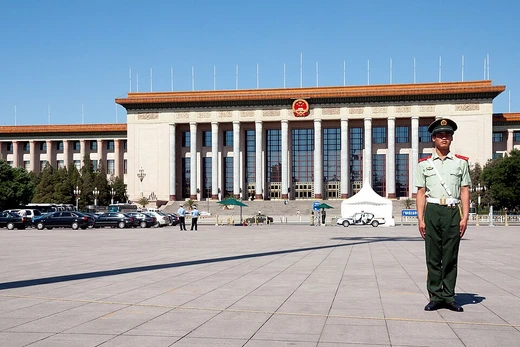
Politics of Egypt
Egypt's political system under el-Sisi faces criticism over authoritarian practices.

Jeff Dahl · CC BY-SA 4.0
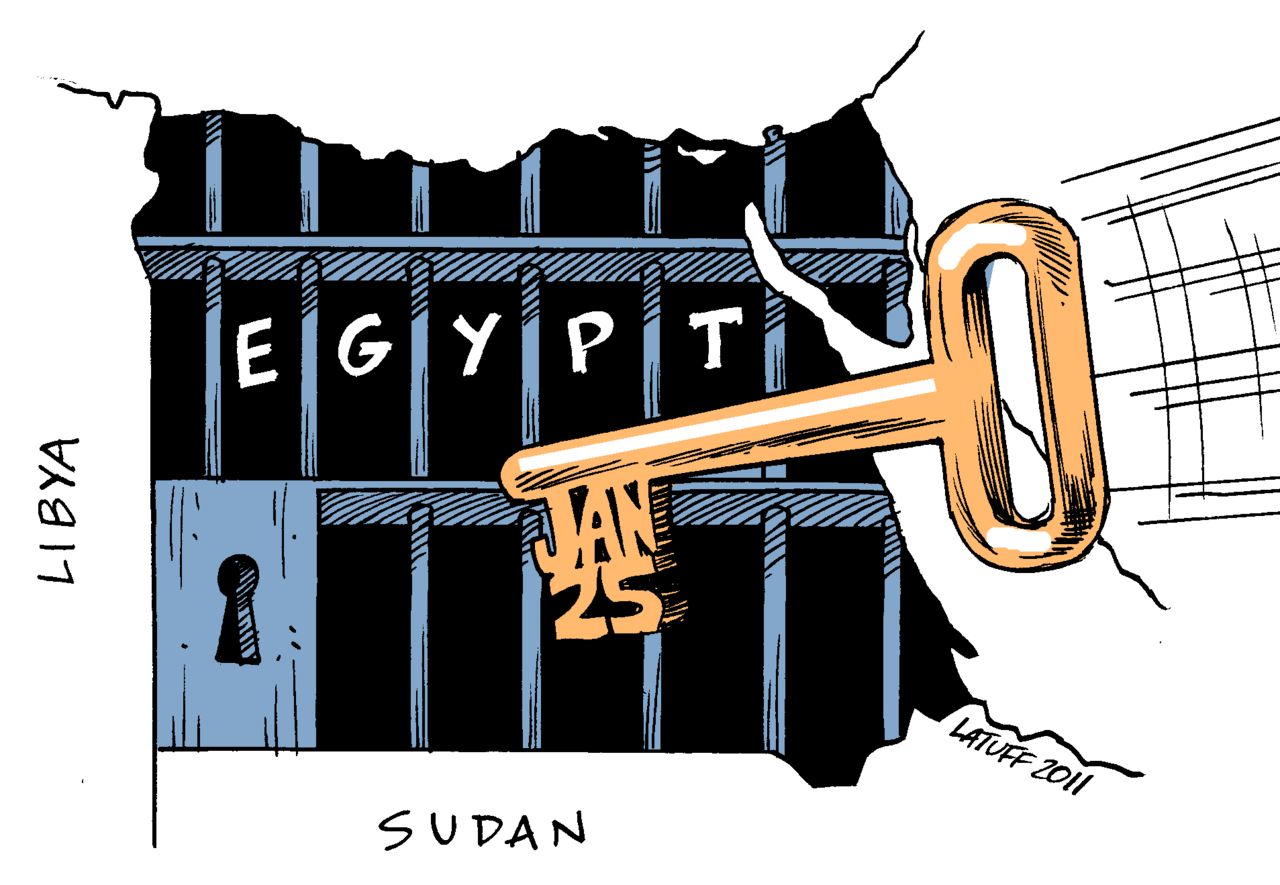
Some scholars, media outlets, and human rights organizations have described Egypt's political system under el-Sisi as authoritarian, citing restrictions on political freedoms, civil liberties, and opposition activity.
- legislature
- Bicameral (House of Representatives and Senate)
Lore & Background
Egypt's judicial branch is independent, comprising ordinary courts, administrative courts (Council of State), and specialized courts, with the Supreme Constitutional Court as the highest authority. Judges are independent and immune to dismissal. The system combines elements of civil law, influenced by the Napoleonic Code, and Islamic law. Political parties are allowed, but religious, race-based, or gender-based parties are prohibited. Before the 2011 revolution, power was concentrated in the presidency and the National Democratic Party.
Reader's Guide
The politics of Egypt under Abdel Fattah el-Sisi represent a continuation of strong executive authority, with the president serving as Supreme Commander of the Armed Forces and holding powers to dissolve parliament and appoint legislators. The 2019 constitutional amendments extended the presidential term and allowed el-Sisi to remain in office beyond previous limits, a change approved by 88.83% of voters with 44% turnout. Critics, including human rights groups and some scholars, have reported restrictions on political freedoms, civil liberties, and opposition activity. The legislature, though formally capable of forcing a cabinet resignation through a motion of censure, continues to lack powers to balance the extensive powers of the president. The judicial branch remains formally independent, but the overall system has been described by some as authoritarian.
Did You Know?
- The president can appoint up to 5% of the total members of the House of Representatives, not a fixed number of 28.
- The 2019 constitutional referendum reset the term count, allowing el-Sisi to run for two additional six-year terms after the current one ended, rather than merely extending the term for future elections.
Historical Emergence and Intellectual Foundations
The field of comparative political theory did not appear in a vacuum. For centuries, political philosophy was dominated by a narrow canon—Plato, Aristotle, Hobbes, Locke, Rousseau, Kant, Marx—all Western thinkers, with non-Western traditions largely excluded from serious academic engagement. The twentieth century began to crack this monopoly, as decolonization movements and postcolonial scholarship challenged the assumption that European and Anglo-American thought represented the universal standard. By the 1990s, comparative political theory had crystallized as its own distinct discipline. Key figures like Amartya Sen and Leo Strauss helped lay intellectual groundwork by examining justice, liberty, and democracy across cultural boundaries. Edward Said's concept of Orientalism further sharpened the field's critical edge, exposing how Western academia had systematically misrepresented non-Western societies. These combined pressures created the space for a genuinely pluralistic political philosophy that no longer treats any single tradition as the default reference point.
Philosophical Mission and Core Objectives
At its heart, comparative political theory pursues a dual mission: it is both descriptive and normative. Descriptively, it seeks to map how political concepts—justice, power, authority, liberty, equality—take different shapes across civilizations and historical periods. Normatively, it offers frameworks for evaluating political institutions and practices without defaulting to any single cultural standard. The field explicitly challenges the universalist claims embedded in Western political theory, arguing that concepts which seem self-evident in one tradition may carry entirely different meanings elsewhere. A central goal is fostering genuine cross-cultural dialogue, where scholars from different intellectual lineages can identify both shared concerns and meaningful divergences. Rather than treating non-Western philosophies as peripheral footnotes to the Western canon, comparative political theory insists they are full participants in a global conversation about how societies should be organized and governed, expanding the canonical boundaries to include indigenous and cross-cultural perspectives.
Methodological Toolkit
Comparative political theory draws on a diverse methodological arsenal. Textual comparison remains foundational: scholars might place Confucian writings on governance side by side with Aristotelian virtue ethics to uncover both convergences and culturally specific interpretations of justice and authority. Conceptual history tracks how ideas like liberty or rights evolve differently across time and place, resisting the temptation to treat them as fixed entities. Genealogical analysis, inspired by Michel Foucault, traces the contingent origins of political concepts to expose hidden power dynamics and dismantle assumptions of universality. Fieldwork and ethnography bring the discipline into contact with lived political practice in non-Western societies, grounding abstract theory in social institutions and cultural routines. Finally, translation and interpretation serve as a critical bridge, since many foundational texts exist in languages far removed from English. Careful translation preserves nuance and guards against the oversimplification that can distort an entire philosophical tradition.
Central Debates and Unresolved Tensions
The field is animated by several live debates. The most fundamental pits universalism against particularism: are concepts like human rights and justice genuinely transcendent, or are they deeply embedded in specific cultural contexts? This tension has no easy resolution. Closely related is the risk of cultural appropriation—scholars must be vigilant against imposing Western analytical categories onto non-Western traditions or flattening complex philosophical systems into easily digestible Western equivalents. A third current, hybridity and syncretism, pushes in a constructive direction, exploring how insights from multiple traditions might be blended into novel political frameworks, such as pairing liberal democratic principles with Confucian ideas of meritocracy and social harmony. Finally, critical scholars interrogate how global power imbalances shape who gets to produce and disseminate political knowledge, urging the amplification of marginalized voices and a sustained challenge to the continued dominance of Western epistemologies in academic discourse.
Gallery


More in Comparative Politics 1-23
Spotted an error? Know more?
This is a living reference — every entry is fact-audited, and reader corrections feed straight into our audit queue. Suggest an edit · See this site's audit record