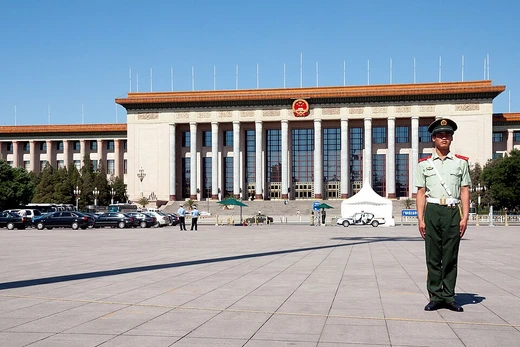
Politics of Italy
Parliamentary republic with frequent coalition governments.

NiloGlock · CC BY-SA 3.0
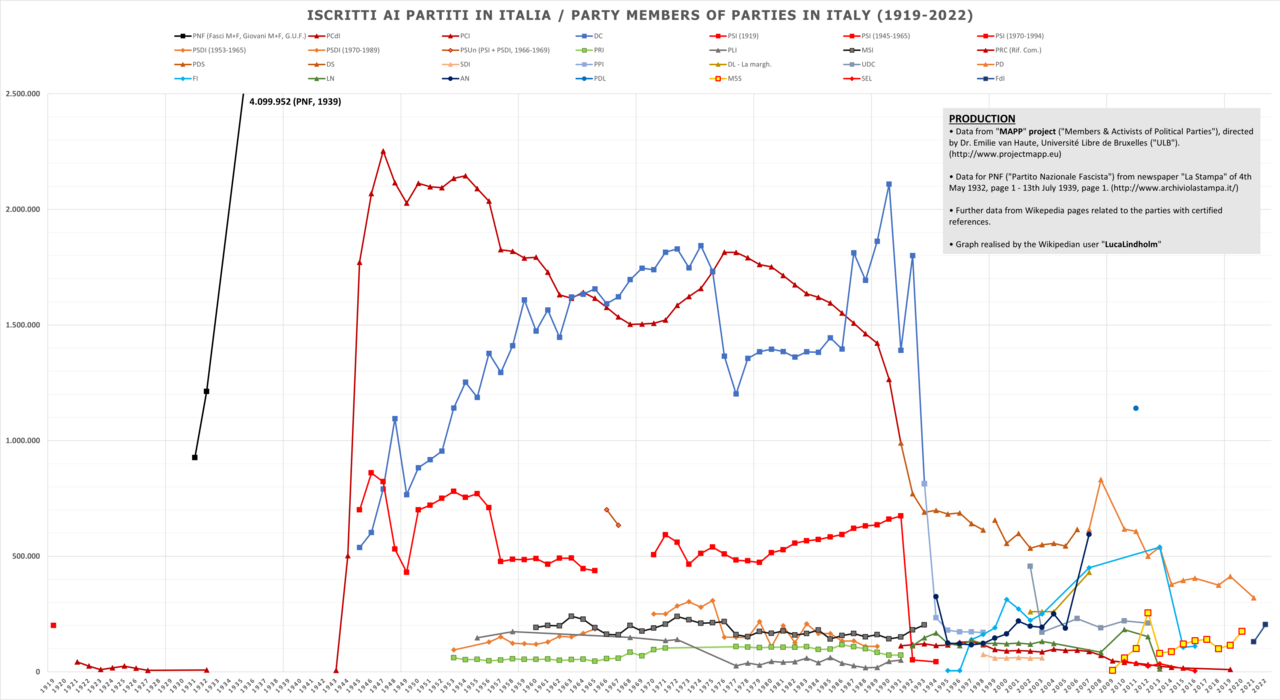
The politics of Italy are conducted through a parliamentary republic with a multi-party system. A high degree of fragmentation and instability, leading to often short-lived coalition governments, is characteristic of Italian politics.
- Government type
- Parliamentary republic
- Head of state
- President of the Italian Republic (currently Sergio Mattarella)
- Head of government
- Prime Minister (President of the Council of Ministers, currently Giorgia Meloni)
- Legislature
- Bicameral Parliament (Chamber of Deputies and Senate of the Republic)
- Number of governments since 1945
- 69
- Average government duration
- 1.11 years
Lore & Background
The President of Italy, as head of state, represents national unity and chairs the High Council of the Judiciary, while executive power is exercised by the Council of Ministers led by the Prime Minister.
Reader's Guide
The judiciary is independent, based on Roman law and the Napoleonic Code, and the President serves as a point of connection between branches. The 2022 general election was the first where both chambers had identical electoral bodies after the voting age for the Senate was lowered to 18.
Did You Know?
- The President of Italy chairs the High Council of the Judiciary and is commander-in-chief of the Italian Armed Forces.
- The Italian constitution was drafted by a constituent assembly formed by representatives of all anti-fascist forces.
Constitutional Foundations and Popular Sovereignty
Italy's current political order traces back to a decisive moment on 2 June 1946, when citizens voted in a referendum to dismantle the monarchy. The anti-fascist forces that had fought to liberate the country from Nazi and Fascist rule then sent representatives to a Constituent Assembly tasked with drafting a new charter. That document, promulgated on 1 January 1948, opened with a declaration that Italy is a democratic republic founded on labour, and that sovereignty rests with the people rather than any hereditary ruler. The framers deliberately used the language of Res Publica to signal that the state belongs to every citizen, not to a ruling family. Those who govern are framed as temporary servants of the community, while the governed are citizens, not subjects. Crucially, the constitution insists that popular power must operate within the forms and limits of the rule of law, preventing arbitrary exercise of authority. This philosophical grounding—demos plus kratìa, tempered by legal constraint—remains the bedrock of Italian political life.
The Architecture of Power – Three Branches in Balance
Italy distributes state authority across three distinct branches. The executive is embodied in the Council of Ministers, headed by the Prime Minister—formally the President of the Council of Ministers—who must retain parliamentary confidence to remain in office. The President of the Republic, currently Sergio Mattarella, sits above this structure as head of state, representing national unity, commanding the armed forces, and chairing the High Council of the Judiciary. Elected by a college of at least 658 members drawn from both parliamentary chambers and 58 regional appointees, the president serves a seven-year term with deliberately fewer powers than the old monarchy. Legislative authority resides in a perfect bicameral Parliament, where the Chamber of Deputies and the Senate perform identical functions separately. The judiciary operates independently of both the executive and the legislature, overseen by the High Council of the Judiciary. The Prime Minister, currently Giorgia Meloni, is ceremonially ranked fourth in the state's order of precedence, behind the president and the two chamber leaders.
A Legacy of Fragmentation and Short-Lived Coalitions
One of the most striking features of Italian politics since 1945 is its chronic governmental instability. In the roughly eight decades following the end of World War II, Italy has cycled through 69 different governments, averaging a new cabinet approximately every 1.11 years. This high degree of party fragmentation and the resulting short-lived coalition arrangements have become a defining characteristic of the Italian political landscape. The multi-party system, while ensuring broad representation, makes durable majorities difficult to sustain, and coalitions frequently fracture under internal pressure. External assessments reflect this tension: the Economist Intelligence Unit classified Italy as a "flawed democracy" in its 2024 assessment, while the 2025 V-Dem indices placed the country at 30th among the most liberal democracies worldwide. These rankings acknowledge that, despite a robust constitutional framework and regular elections, the practical reality of governance in Italy is marked by frequent transitions, shifting alliances, and a persistent challenge in maintaining stable executive authority over time.
The Bicameral Parliament – Two Houses, One Voice
Italy's legislature operates as a perfect bicameral system, meaning the two chambers carry out identical legislative functions but do so independently. The lower house, the Chamber of Deputies, comprises 400 members—392 elected from domestic constituencies and 8 representing Italian citizens abroad. Its members, styled "The Honourable," convene at Palazzo Montecitorio in Rome. The upper house, the Senate of the Republic, has 200 elected members (196 domestic, 4 overseas) plus a variable number of senators for life, currently six, who are either appointed by the President or qualify by virtue of having previously held the presidency. Senators are addressed as "The Honourable Senator" and meet at Palazzo Madama. Both houses are elected on a five-year cycle under the constitutional guarantee of the right to vote. This dual structure ensures that legislation must pass through two separate deliberative bodies before becoming law, embedding a built-in check on hasty or one-sided decision-making.
Gallery


More in Comparative Politics 1-23
Spotted an error? Know more?
This is a living reference — every entry is fact-audited, and reader corrections feed straight into our audit queue. Suggest an edit · See this site's audit record